Physical Address
304 North Cardinal St.
Dorchester Center, MA 02124
Physical Address
304 North Cardinal St.
Dorchester Center, MA 02124

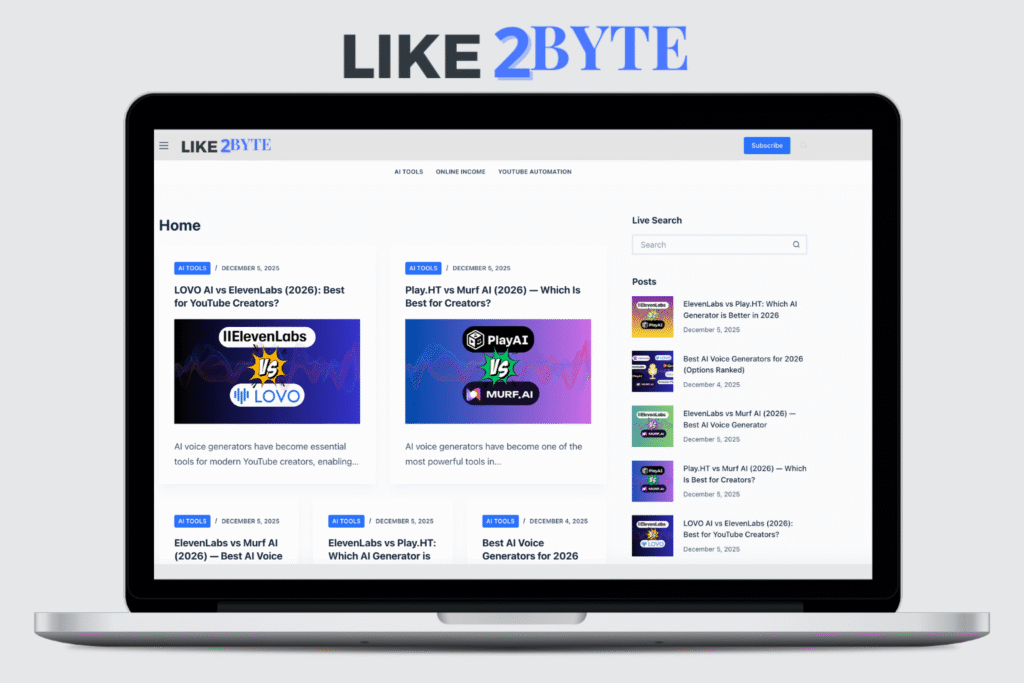
Like2Byte is a how-to focused tech publication built for people who want clear answers, trustworthy comparisons, and practical guidance without the hype. We publish in-depth guides, technical breakdowns, and workflow experiments across AI Agents & Coding, Local AI & Hardware, Generative Media, AI Voice & Audio, and AI Business & Automation — with an emphasis on repeatable processes, real testing, and transparent limitations.
Our goal is simple: help you make better decisions faster. That means explaining what to build, why it works, and where it breaks, so you’re not stuck following generic advice that fails under real-world conditions.
The internet is overflowing with “top 10” lists and rewritten summaries. Like 2 Byte exists to publish content that’s harder to fake: content based on hands-on testing, clear methodology, and honest reporting about results.
When we recommend a tool, workflow, or strategy, we aim to show the path from setup → test → result. If something is speculative or depends on variables (budget, traffic, region, device limitations), we’ll say so.
All content published on Like2Byte is intended for educational and informational purposes only. While we regularly analyze tools, pricing models, automation systems, and business use cases, our content reflects an independent opinion — not personalized financial, legal, or professional advice.
Before making financial, technical, or business decisions, readers should conduct their own research and consult qualified professionals when appropriate. Individual results may vary depending on resources, experience, and market conditions.
The name reflects the spirit of the project: keep it technical, keep it practical, and keep it simple enough to apply. Two bytes are small—but structured. That’s how we think good how-to content should be.

Like2Byte focuses on areas where readers usually get stuck: understanding market changes, choosing the right tools, designing workflows, and figuring out what actually works when marketing promises don’t match real-world results.
Instead of chasing hype or quick answers, we focus on context, trade-offs, and decision-making — helping readers understand not just what to use, but why, when, and at what cost.
In an era of AI-generated noise, judgment is the most valuable currency. We don’t just summarize documentation or repeat marketing claims. We analyze outcomes, trade-offs, and failure modes — especially where tools break under real-world conditions.
Our goal is not to list features, but to help readers understand what actually changes when a tool is used inside a real workflow, at scale, and under constraints like time, cost, and quality control.
We build articles to be useful even if you only read the headings, and deep enough that advanced readers can still learn something new.
| Section | What you get |
|---|---|
| Quick answer / summary | The fastest correct path (and who it’s for) |
| Step-by-step | Exact settings, screenshots, and order of actions |
| Testing notes | What worked, what failed, and why |
| Market consensus | What practitioners and communities agree on — and where they disagree |
| Alternatives | When another tool or workflow is the better choice |
| FAQ | Edge cases, common errors, and real-world fixes |
Like2Byte uses AI as a research and productivity tool — not as an autonomous publisher.
In practice, AI helps us accelerate tasks such as data aggregation, outline structuring, and scenario comparison. It allows us to process more information efficiently, especially in fast-moving areas like AI tools, pricing changes, and workflow design.
However, editorial judgment, topic selection, conclusions, and recommendations are always human-driven. Every article is reviewed, adjusted, and validated by a human editor before publication.
We do not publish fully automated content. AI-generated drafts are treated as working material, not final output.
Not every topic requires reinventing the wheel. When a tool, workflow, or platform has already accumulated substantial real-world usage, we apply our Analytical Curation methodology.
This means synthesizing insights from:
The result is not a summary, but a filtered, opinionated synthesis designed to save readers time and reduce decision risk.
When we run hands-on tests ourselves, we clearly state it. When insights come from curated external evidence, we treat them with the same editorial scrutiny.
Our goal is simple: use AI to increase analytical capacity — not to replace responsibility.
Testing matters because most AI tools look great in isolation. The real question is whether they still work when placed inside real workflows, under deadlines, cost constraints, and imperfect inputs.
At Like2Byte, we use a hybrid testing methodology. Some tools and workflows are tested hands-on in real projects. Others are evaluated through structured analytical curation when full internal testing is impractical or unnecessary.
For tools and workflows that directly impact production, cost, or scalability, we run hands-on tests. This includes building pipelines, generating outputs repeatedly, tracking failure modes, and observing how performance changes with volume.
Not every tool requires reinventing the wheel. When long-term internal testing is impractical, we apply our Analytical Curation methodology.
This approach combines technical documentation, real-world usage data, feedback from specialized communities (such as Reddit, GitHub issues, and niche forums), and expert reviews. Our goal is not to repeat opinions, but to synthesize patterns, contradictions, and failure points into a single, decision-focused analysis.
In practice, this means identifying where users agree, where experiences diverge, and which limitations only appear after sustained usage — insights that rarely surface in marketing pages or surface-level reviews.
We are explicit about the nature of each evaluation. When an article is based on hands-on testing, we say so. When it relies on analytical curation and community data, we state that clearly.
Our priority is accuracy and usefulness — not pretending every article comes from months of isolated internal testing.
Like many publications, Like2Byte may use affiliate links. If you click an affiliate link and make a purchase, we may earn a commission at NO additional cost to you.
Sponsored content (if we ever publish it) should be clearly labeled as “Sponsored” or “Advertisement”.
Tools change fast. Pricing changes. Features get removed. If we learn something is inaccurate or outdated, we update the article. When a change materially impacts the recommendation, we’ll rewrite the relevant section.
If you find an error, send the URL of the page and a short description of the issue. If possible, include screenshots or steps to reproduce.
Like2Byte is built with a “small team, high standards” mentality. In an era of automated noise, we believe that expert judgment is the most valuable currency. We don’t just publish content; we provide a filter for the rapidly changing AI landscape.
The editorial team behind Like2Byte direct, hands-on experience operating automated content pipelines. This “in-the-trenches” background allows us to spot the difference between a tool that looks good in a demo and one that actually survives a professional workflow. Our expertise comes from running real-world experiments in monetization, scalability, and AI integration.
Our Stance on AI-Assisted Content: To maintain the pace of the AI market, we use advanced AI tools to help us process data, structure drafts, and cross-reference information. However, no article is published without rigorous human oversight. Every final verdict, strategic insight, and “red flag” mentioned in our posts is the result of human analysis and a commitment to factual accuracy.
Curated Intelligence: When we haven’t spent months with a specific tool, we apply a “Triangulation Method”: we synthesize technical documentation, verified user feedback from developer communities (like Reddit and GitHub), and pricing data to give you a consolidated, honest perspective. We do the heavy lifting of research so you can make informed decisions in minutes, not days.
For general inquiries, correction requests, or partnership questions, use our contact page: https://like2byte.com/contact/
If you’re reaching out about a specific article, include the link and the exact section you’re referring to.