Physical Address
304 North Cardinal St.
Dorchester Center, MA 02124
Physical Address
304 North Cardinal St.
Dorchester Center, MA 02124

If you’re searching for “ElevenLabs vs Play.ht” in 2026, the landscape has changed: Play.ht was acquired by Meta and its services were shut down in late 2025. This article is no longer a head-to-head comparison, but a roadmap for what comes next.
At Like2Byte, we test AI tools inside real workflows to answer the only question that matters: “What actually works now that a leader in long-form narration is gone?”
This guide maps Play.ht’s legacy strengths to ElevenLabs and other modern alternatives, showing you how to migrate your production and rebuild your workflow with minimal friction.
If you’re exploring the broader AI narration landscape, start with our full guide to the Top 10 Best AI Voice Generators for 2026.
🚀 TL;DR — Which AI Voice Tool Should You Use in 2026?
👉 Play.ht previously covered many of these use cases, but has been discontinued. Migration paths are explained below.
The transition from an independent startup to a Meta-owned subsidiary was swift. If you had hours of generated audio or, more importantly, custom voice clones stored in the PlayAI dashboard, here is the current situation as of January 2026.
1. The “Grace Period” has ended: Meta officially closed the data export window on December 31, 2025. Most legacy accounts are now locked, and the cloud-hosted projects are being purged to comply with Meta’s internal data privacy policies as they integrate the technology into their Llama-voice ecosystem.
At Like2Byte, we’ve seen this “acquisition sunset” happen before. The hard truth is that Meta is more interested in the underlying IP than in maintaining a SaaS platform for creators. If you’re stuck, your best move now is to look forward and establish a new baseline with an active provider.
One of the most common questions for creators in 2026 is: “How does the cost of ElevenLabs compare to my old Play.ht plan?” Since you can no longer subscribe to Play.ht (PlayAI), understanding the pricing shift is critical for your budget.
Historically, Play.ht was known for its “unlimited” plans and affordable long-form narration. ElevenLabs operates on a character-based credit system, which requires a different approach to content planning.
| Plan Tier | Play.ht (Legacy Reference) | ElevenLabs (2026 Replacement) | Best For |
| Free Tier | 5,000 characters/mo (Limited) | 10,000 characters/mo | Testing quality & short clips |
| Entry Level | ~$9/mo (Personal) | ~$10/mo (Starter) | YouTube Shorts & Social Media |
| Professional | ~$39/mo (Professional) | ~$22/mo (Creator) | Full-length YouTube & Podcasts |
| High Volume | Custom / Enterprise | $99+ (Pro/Scale) | Agencies & Audiobook Publishers |
| What Play.ht Was Used For | Best Replacement in 2026 | Why This Works |
|---|---|---|
| Expressive YouTube narration | ElevenLabs | More natural pacing, emotional delivery, and higher audience retention |
| Long-form neutral narration (courses, audiobooks) | ElevenLabs (stable voices + segmentation) | Closest active option for long scripts when configured for consistency |
| Pronunciation control and repeatable terminology | ElevenLabs + workflow QA | Recreate dictionaries through saved voice settings and review passes |
| Team-based training and slide-driven content | Murf AI | Studio workflow, timelines, and collaboration features |
| Multilingual business narration | Murf AI or ElevenLabs | Murf for corporate tone; ElevenLabs for creator-style delivery |
Instead of judging these platforms only by feature lists, we focused on how they behaved inside real production workflows. Our testing was conducted while Play.ht was still active, allowing us to observe how creators and teams actually used both tools in day-to-day scenarios.
We built sample projects that mirror common use cases: faceless YouTube videos, automated content pipelines, long-form online courses, internal training modules, and audiobook-style narration. For each scenario, we evaluated setup time, narration quality, editing friction, and how easily each tool fit into an existing workflow.
We also tested reuse and scale. Our scenarios included solo creators working independently as well as small teams where writers, editors, and managers all interacted with the same project. This revealed where ElevenLabs’ expressiveness meaningfully improved engagement — and where Play.ht’s long-form stability historically reduced rework in extended narration projects.
| Scenario | What We Tested | ElevenLabs Observations | Play.ht (Legacy) Observations |
|---|---|---|---|
| Faceless YouTube video | 10–15 minute documentary or explainer with hooks and story beats | Expressive pacing and emotional variation increased perceived narrator personality | Clear, steady delivery suited for educational-style videos |
| Long-form course | Multi-module e-learning script with lessons and recap sections | Engaging intros and examples improved lesson flow | Highly consistent tone across modules with easy pronunciation tuning |
| Audiobook-style chapter | 30–40 minutes of continuous narration | Cinematic delivery worked well for storytelling and creative non-fiction | Neutral, predictable narration ideal for instructional or business books |
| YouTube automation workflow | Batch generation for recurring content series | Fast generation with expressive delivery for audience retention | Reusable settings and stable output for serialized content |
Keep this testing context in mind as you read the rest of this guide. Our conclusions are based on how ElevenLabs and Play.ht actually behaved in production scenarios — and how those historical strengths can be replaced or re-created now that Play.ht is no longer active.
Since Play.ht is no longer an active platform, this section reframes the comparison as a migration-oriented analysis. Instead of asking which tool is “better today,” the goal is to understand which Play.ht strengths matter most — and how effectively ElevenLabs replaces or improves upon them in modern creator workflows.
One of the clearest reasons creators migrate away from legacy narration engines is expressiveness. ElevenLabs models speech the way a professional voice actor performs a script — using micro-pauses, emphasis shifts, emotional timing, and energy variation aligned with meaning.
This results in narration that feels responsive and alive, especially in formats like YouTube documentaries, explainers, storytelling videos, and narrative-driven content where engagement directly impacts retention.
Legacy contrast: Play.ht intentionally avoided emotional fluctuation, prioritizing clarity and neutrality. While effective for instructional material, this approach limited expressive depth and made it less suitable for modern, engagement-first platforms.
Migration takeaway: If your Play.ht use case involved audience-facing narration, ElevenLabs is a clear upgrade in realism and performance.
Emotional range in AI narration goes beyond simple mood labels. It includes pacing, emphasis, pitch modulation, articulation, and how delivery adapts to narrative context. ElevenLabs excels in this dimension, dynamically adjusting performance across different parts of a script.
This capability allows creators to maintain listener interest across longer videos, complex explanations, or emotionally driven stories — a key factor in YouTube retention and watch time.
Legacy contrast: Play.ht deliberately constrained emotional variability to avoid tonal drift in long scripts. While this helped with consistency, it limited engagement in narrative-heavy content.
Migration takeaway: For creators moving away from Play.ht, ElevenLabs offers more expressive control without sacrificing intelligibility.
Long-form narration was historically Play.ht’s strongest area. Its engines were optimized for stability across 30–60+ minute scripts, minimizing tone drift and pacing inconsistency.
ElevenLabs approaches long-form differently. Its expressive models may introduce slight variations in energy across long recordings — which can enhance storytelling, but may require more attention when producing strictly instructional or compliance-driven material.
That said, many former Play.ht users now successfully produce audiobooks and long-form content with ElevenLabs by standardizing voice settings and segmenting scripts into controlled sections.
Migration takeaway: ElevenLabs can fully replace Play.ht for long-form projects, but works best when paired with structured scripting rather than single, monolithic renders.
ElevenLabs stands out in multilingual narration by preserving emotional nuance, accent authenticity, and natural rhythm across languages. This is especially valuable for global creators producing localized versions of the same content.
Legacy contrast: Play.ht supported multiple languages, but its delivery outside English tended to be more standardized and neutral — suitable for training, but less engaging for storytelling.
Migration takeaway: For multilingual creators coming from Play.ht, ElevenLabs delivers a noticeable improvement in naturalness and listener engagement.
ElevenLabs emphasizes speed, simplicity, and automation. Scripts can be generated quickly and integrated directly into content pipelines, making it ideal for recurring production workflows and solo creators.
Legacy contrast: Play.ht offered advanced SSML-based editing, detailed pause control, and timeline-style adjustments — features valued by professional editors, but also a source of friction for fast-moving creators.
Migration takeaway: Most creators accept the tradeoff in favor of speed and expressiveness. For teams that previously relied on Play.ht’s granular controls, combining ElevenLabs with external audio editors often provides a more flexible modern setup.
For former Play.ht users, ElevenLabs delivers a strong return on investment by combining expressive voice quality with lower entry pricing and faster production cycles.
While Play.ht historically justified higher pricing through long-form stability and editorial controls, many creators now offset this difference by:
This approach allows ElevenLabs to replace Play.ht in most workflows while reducing monthly costs and increasing audience engagement — particularly on platforms where retention and watch time matter.
ElevenLabs introduced voice models that capture behaviors traditionally associated only with human narrators:
Why this matters: Human listeners instinctively respond to emotional cues, pacing, and tonal variation. These elements transform narration from simple text reading into communication that feels alive and intentional.
Example: In a suspense documentary, a deliberate pause before a reveal or a softened tone during a tense moment can significantly increase engagement. ElevenLabs captures these nuances, often resulting in higher viewer retention on platforms like YouTube.
Between 2023 and 2025, YouTube automation expanded rapidly. Channels producing explainers, documentaries, historical narratives, finance breakdowns, and news summaries needed narration that was expressive, scalable, and fast to generate.
Many creators reported a 15–25% increase in viewer retention after switching from older TTS engines to ElevenLabs. Because retention is a key signal in YouTube’s recommendation algorithm, ElevenLabs quickly became the default narration engine for automated content workflows.
ElevenLabs’ growth was driven largely by creator adoption and community sharing. Comparison videos, voice cloning demos, and influencer reviews consistently highlighted its realism, reinforcing its reputation as the most natural-sounding AI voice generator. This organic momentum pushed the entire industry forward and set new expectations for expressive AI narration.
Long-form narration introduces challenges such as tone drift, pacing inconsistency, and pronunciation variation. Play.ht was engineered specifically to minimize these issues, maintaining a steady tone and predictable rhythm throughout lengthy scripts.
Example: In a 45-minute onboarding module or a multi-chapter audiobook, dramatic emotional shifts can distract listeners and reduce comprehension. Play.ht’s neutral delivery ensured clarity and continuity across extended sessions.
Play.ht provided advanced narration-focused editing tools, including:
This environment allowed producers to fine-tune narration with studio-level precision, often reducing the need for external audio editing tools in course and audiobook production.
Play.ht’s voice catalog covered a wide range of professional tones — corporate, instructional, conversational, and formal — across many languages. While less expressive than ElevenLabs, this diversity helped teams match specific brand and compliance requirements, especially in educational and enterprise environments.
ElevenLabs TTS is built around expressive speech modeling, prioritizing emotional dynamics, contextual emphasis, and natural pacing. Instead of treating text as a flat input, its models simulate how human narrators vary pitch, tempo, intensity, and timing based on meaning and narrative context.
This approach allows ElevenLabs voices to behave more like digital voice actors than traditional text-to-speech engines. The result is narration that adapts fluidly to storytelling, commentary, persuasive content, and creator-driven formats where personality and engagement directly affect retention.
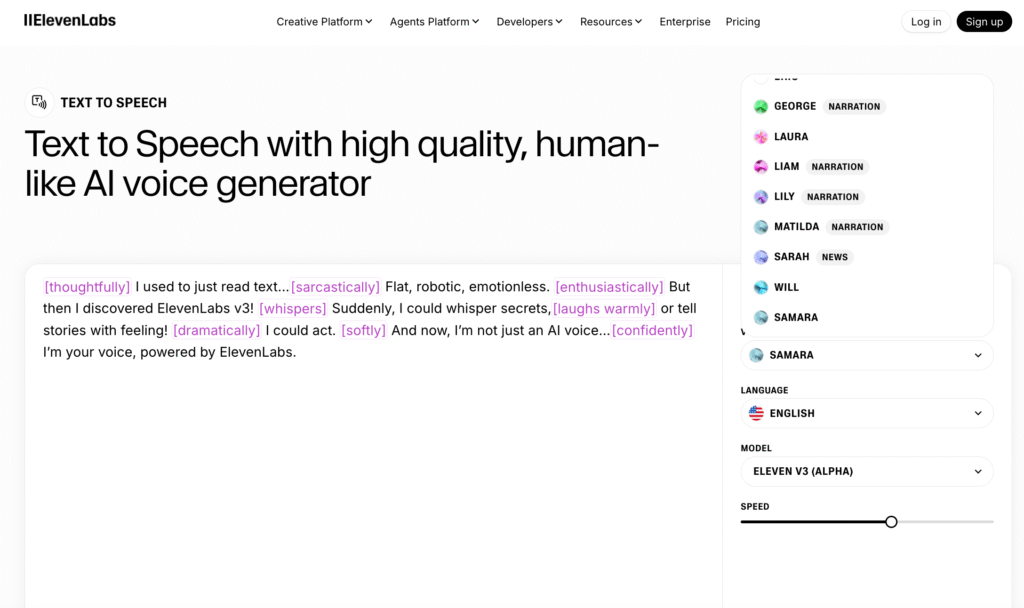
From a technical standpoint, ElevenLabs represents the current direction of AI narration: models that optimize not only for intelligibility, but for emotional realism, listener engagement, and performance quality. This is precisely why it has become the primary migration choice for creators coming from legacy platforms like Play.ht.
Before its shutdown, Play.ht followed a very different technical philosophy. Its voice synthesis minimized emotional variation and tonal drift in favor of predictable, stable delivery, especially across long scripts such as audiobooks, courses, and corporate training material.
This consistency-first approach worked well for structured, instructional content, but it also limited expressive range. As creator workflows shifted toward engagement-driven platforms like YouTube and short-form video, this tradeoff became increasingly visible.
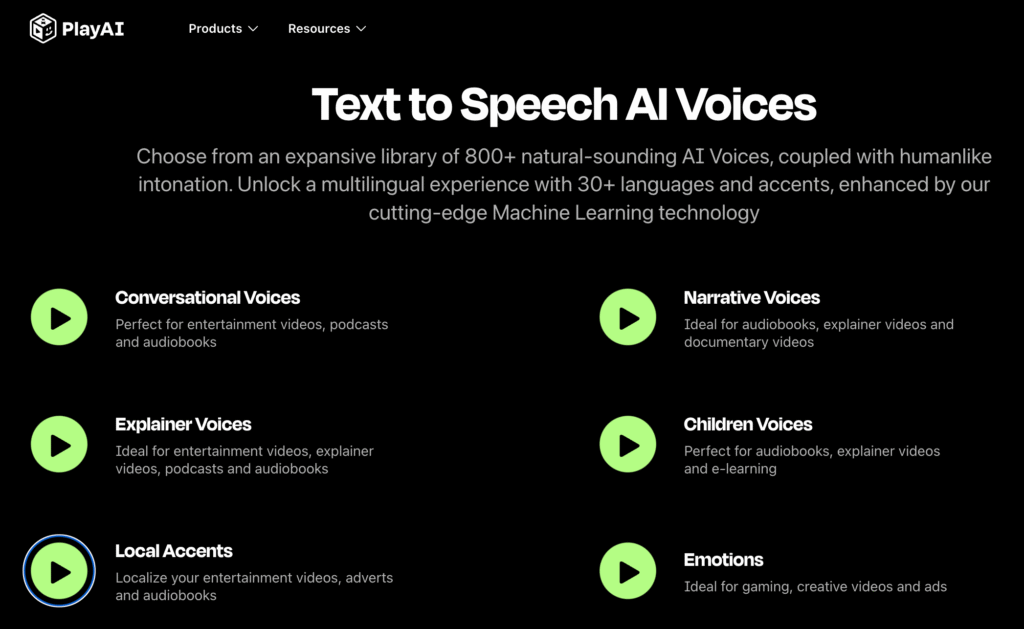
In retrospect, Play.ht can be seen as a long-form narration benchmark rather than a forward-looking architecture. Its strengths highlight why modern creators now prioritize expressive engines like ElevenLabs, while still valuing the stability lessons learned from earlier platforms.
With Play.ht no longer active, the decision in 2026 is no longer about choosing between two competing platforms — it’s about selecting the right replacement based on how you actually produce content.
If your work depends on emotion, engagement, and narrative performance — especially for YouTube, faceless channels, documentaries, storytelling podcasts, or promotional content — ElevenLabs is the strongest all-around choice. Its voices behave like real performers, delivering natural pacing, emotional nuance, and higher audience retention.
For creators who previously relied on Play.ht for long-form narration (audiobooks, courses, onboarding, structured education), ElevenLabs now serves as the closest modern alternative. By using segmented scripts, consistent voice settings, and standardized pacing, most Play.ht workflows can be migrated successfully — often with improved realism.
In short: the Play.ht era has ended, but its core use cases did not disappear. ElevenLabs absorbed most of that demand — while also unlocking far greater expressive range for creators who want their narration to feel human.
ElevenLabs currently delivers the most human-like AI voices available to creators. Its models capture emotional intonation, micro-pauses, breath control, and emphasis patterns that closely resemble professional voice actors.
There is no one-to-one clone of Play.ht, but ElevenLabs is the closest practical replacement. By splitting long scripts into structured segments and standardizing voice settings, creators can replicate most Play.ht workflows — often with higher realism.
ElevenLabs performs best on YouTube because emotional delivery directly impacts viewer retention. Many creators report measurable increases in watch time after switching from older TTS engines.
If your workflow is heavily studio-based (slides, timelines, multiple reviewers), tools like Murf AI may complement ElevenLabs. However, for narration-first creators, ElevenLabs remains the primary engine.
Yes. While Play.ht historically dominated this niche, ElevenLabs is now widely used for audiobooks, courses, and training by applying consistent voice presets and modular script structure.
Yes. ElevenLabs is one of the easiest platforms to start with: paste a script, select a voice, and generate. Advanced users can still build sophisticated pipelines on top of it.
Yes. Commercial usage is supported on paid plans, but licensing terms vary by tier, voice type, and features such as voice cloning. Always verify current terms on the official ElevenLabs website.
For most creators, yes. ElevenLabs offers one of the best price-to-quality ratios in AI voice generation, especially when factoring in engagement, retention, and output realism.
Yes. ElevenLabs is widely regarded as one of the leaders in expressive voice cloning, with clones capable of carrying emotional nuance and natural cadence.
From a long-term perspective, ElevenLabs is the safest bet for narration-first creators. Its rapid development, adoption curve, and expressive advantage position it as the dominant successor in the post-Play.ht landscape.
