Physical Address
304 North Cardinal St.
Dorchester Center, MA 02124
Physical Address
304 North Cardinal St.
Dorchester Center, MA 02124


Quick Answer: Telecom customer journey orchestration is a profit system—not a CX slogan.
Quick scenario: your customer’s internet drops. They can’t check your status page. They call support and hear an IVR message telling them to “do everything online.” That single moment destroys trust—and it’s a perfect example of why the telecom customer journey is now a board-level profit problem.
So what is telecom customer journey orchestration? It’s using real customer events—activation, billing, usage, support—to trigger the next best action across channels in real time. Not “more campaigns.” A system that prevents friction before it becomes churn.
2026 freshness: journeys are expanding beyond terrestrial networks. Direct-to-cell satellite services are moving closer to real-world rollout, adding new onboarding and support states (coverage transitions and expectation-setting). Source (Reuters)
Mapping is a diagram: the steps a persona might take to activate a plan, fix a router, or pay a bill. It’s useful for finding bottlenecks.
Orchestration is execution: coordinating a real customer’s journey across app, web, SMS, email, and voice—so they don’t lose context, receive conflicting messages, or get stuck without help.
In this guide, I’ll stay practical. You’ll get an onboarding blueprint (Brevo-powered), a churn reduction playbook (including involuntary churn), a simple ROI model, and a CEO-ready platform comparison—so you can pick a journey to fix and ship improvements fast.
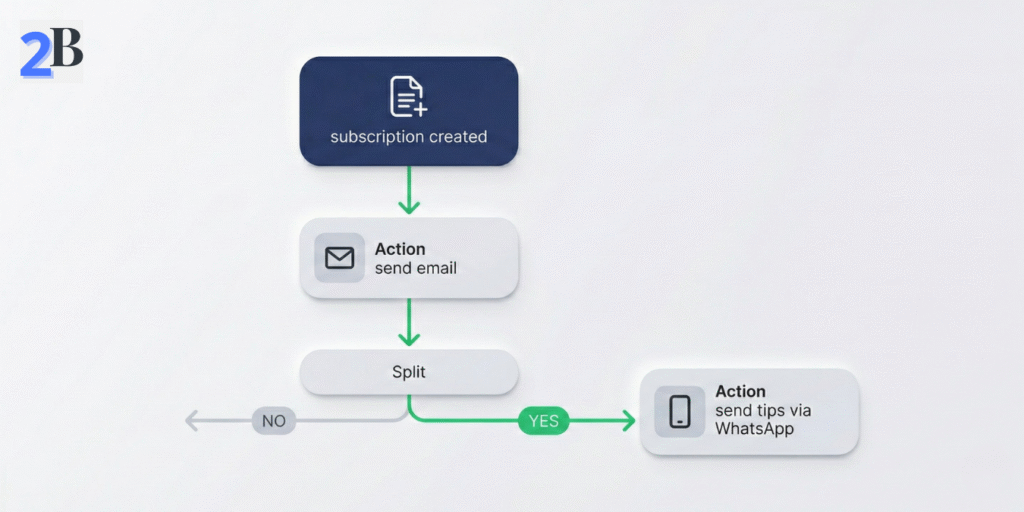
In telecom, onboarding is not a “welcome series.” It’s a profit gate. A clean onboarding flow compresses time-to-activation, reduces early support load, and prevents the silent churn that happens before customers ever experience real value. When onboarding is fragmented—KYC in one place, provisioning in another, billing somewhere else—cost-to-serve rises and trust collapses fast.
This blueprint shows how to orchestrate onboarding using Brevo as the journey layer: event-driven triggers, cross-channel messaging (email/SMS/WhatsApp where appropriate), and a minimal data model that keeps teams aligned. Note: Brevo pricing scales with usage and channels; treat public plan pricing as an anchor, not a telco-scale budget. Source (Brevo pricing)
For most Tier-2/3 operators, early churn is rarely “price-only.” It’s friction: slow verification, unclear activation steps, missing status updates, and a first bill that feels like a surprise. The fastest way to improve the telecom customer journey is to design onboarding around a few decisive moments and trigger actions based on real milestones—not calendar-based campaigns.
In practice, these are the onboarding chokepoints that matter:
CEO lens: if you can only optimize one thing first, optimize time-to-activation and billing trust. Those two moments usually drive the largest immediate reduction in tickets and early cancellations.
Automated onboarding at telecom scale depends on one thing: reliable events. Brevo is most effective when it’s fed with real-time signals from your systems of record—CRM, billing, and provisioning—so it can orchestrate the right message, in the right channel, at the right moment. You don’t need “perfect data.” You need consistent identifiers and clean triggers.
Implementation pattern (high-level):
If you want a concrete reference for the integration mechanics, Brevo documents how to set up and consume webhook events for real-time tracking. Source (Brevo webhooks documentation)
| Stage/Touchpoint | Brevo Automation Element | Integrated Data Source | ROI Driver (practical) |
|---|---|---|---|
| Identity Verification | API-triggered email/SMS + conditional reminders | IDAM / eKYC provider | Fewer manual checks, fewer stalled activations |
| Device/SIM Activation | Status updates + “needs action” nudges | Provisioning / OSS APIs | Shorter time-to-activation, fewer setup tickets |
| First Bill Setup | Transparent explainer + payment method prompts | Billing system / CRM | Fewer disputes and failed payments early on |
| Consent & Compliance | Consent capture + suppression rules | Consent registry / CDP | Lower regulatory risk, higher deliverability |
| Onboarding Communications | Behavior-based welcome flow (milestones, not dates) | Unified customer profile | Faster first-use, higher adoption of self-serve |
When onboarding automation is engineered around events and identity, it converts operational drag into measurable outcomes: fewer early tickets, faster activation, and higher billing trust. Next, we extend the same orchestration logic beyond onboarding into churn intervention and lifetime value protection.
Churn isn’t a customer problem—it’s a margin problem. In telecom, even small retention improvements compound because they protect recurring revenue and reduce the cost-to-serve. The goal in 2026 is not “run more win-back campaigns.” It’s to shift retention from reactive firefighting into systematic intervention: detect risk early, trigger the right action automatically, and escalate to humans only when it’s economically justified.
One practical nuance: a meaningful share of churn in subscription businesses can be involuntary (payment failures, expired cards, failed retries). The exact split varies by market and payment rails—but the strategic takeaway is consistent: fixing billing friction can be one of the fastest ROI levers in retention. Source (ChurnKey retention report)
Most churn prevention fails because operators respond too late. By the time a customer asks to cancel, the journey has already broken: unresolved issues, repeated contacts, unclear billing, or low perceived value. Event-driven automation fixes timing. It continuously watches for leading indicators—and triggers an intervention while recovery is still cheap.
CEO lens: you don’t need “perfect AI” to start. A small, reliable event model + clear escalation rules can outperform a fancy model that isn’t connected to real operations.
The highest-ROI retention workflows typically target two areas first: billing trust (involuntary churn) and resolution speed (repeat-contact churn). Below are battle-tested workflows that can run through Brevo as the orchestration layer (email/SMS/WhatsApp) while CRM, billing, and support systems remain the source of truth.
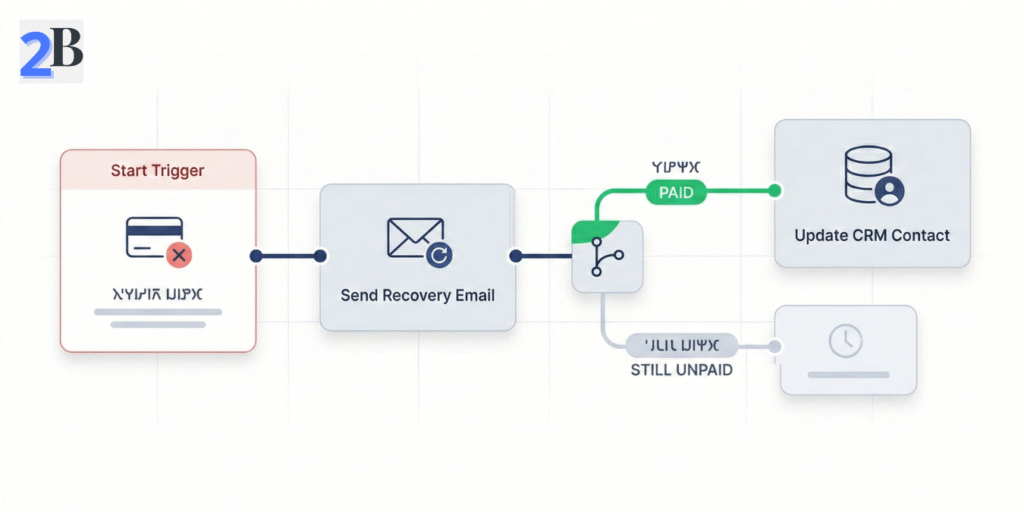
If you want a fast win, start here. Involuntary churn is often “invisible churn”—customers don’t necessarily want to leave; the payment simply fails and the experience degrades. The blueprint is simple: use billing events as triggers, then recover payments with a calm, low-friction sequence.
card_expiring_30d) → “Update payment method” message + 1-click path (where allowed).payment_failed) → dunning sequence with timed retries + clear support path.payment_recovered) → confirmation + short “billing clarity” note to prevent disputes.Practical metric: measure recovery rate and time-to-recovery. Even a modest improvement often protects meaningful revenue at scale—without adding headcount.
One of the most expensive forms of churn is “support fatigue”—customers repeating the same issue across channels. A retention system should eliminate that. If a customer opens a payment-failure message and calls support 10 minutes later, the agent should immediately see the context: the campaign opened, workflow step, last billing event, and recommended next action. That is zero-context loss.
| Churn Driver | Automated Workflow | Profit Impact (expressed as outcomes) |
|---|---|---|
| Repeat support contacts | Auto-prioritize + proactive follow-up + “zero-context loss” handoff | Fewer repeat calls, faster resolution, lower cost-to-serve |
| Payment failures (involuntary churn) | Expiry prevention + dunning sequence + smart escalation | Higher payment recovery, fewer cancellations triggered by billing friction |
| Usage drop / disengagement | Re-engagement flow tied to the customer’s actual state (setup, value, coverage, plan fit) | Improved retention in “silent churn” segments |
| Negative CSAT/NPS signal | Immediate apology + service review + targeted remedy path | Reduced downstream churn from unresolved dissatisfaction |
When churn automation is engineered around events, economics, and escalation rules, it becomes a predictable retention engine—not a marketing experiment. Now, we’ll quantify ROI in a way that executives can validate quickly (with transparent assumptions), and we’ll cover the most common implementation pitfalls that kill time-to-value.
Journey orchestration only matters if it shows up in board metrics: protected revenue, lower cost-to-serve, and faster time-to-value. In 2026, the telecom customer journey is getting more complex (more devices, more channels, more expectations), while margins remain under pressure. The winning approach is to treat orchestration as a revenue enablement system with clear measurement and hard operational guardrails—not as an “IT transformation” with vague outcomes.
For context on why complexity keeps rising: mobile traffic growth and multi-device behavior continue to intensify demand on networks and service operations—making proactive, event-driven journeys more valuable. Source (Ericsson Mobility Report)
Skip vanity metrics. Track indicators that connect orchestration to profit mechanics. The simplest executive framework is to measure outcomes across three buckets: retention, efficiency, and expansion.
CEO lens: pick one primary KPI per initiative (e.g., “payment recovery rate” for dunning, “time-to-activation” for onboarding) and one cost KPI (e.g., “tickets per 1,000 subs”). If you track too many metrics, you won’t ship improvements fast enough.
Instead of claiming universal benchmarks, use an assumptions-based model and let the reader plug in their numbers. The financial impact of churn reduction can be estimated as:
Annual savings from churn reduction
$$S = (B \times \Delta C) \times ARPU \times 12$$
Where $B$ is subscriber base, $\Delta C$ is churn reduction (absolute), and $ARPU$ is average revenue per user.
Example (illustrative): If you have 50,000 subscribers, ARPU of $50, and orchestration reduces churn by just 0.2 percentage points (absolute), the annual revenue protected can be material. The point isn’t the exact number—it’s that small churn deltas compound when multiplied by base size and time.
For a more complete picture, track two additional ROI lines alongside $S$:
(1) cost-to-serve savings (fewer tickets + shorter handling time), and (2) incremental expansion revenue (upgrades triggered by verified usage and intent).
Orchestration failures are rarely caused by “missing AI.” They fail because the organization can’t connect systems, define ownership, or enforce data discipline. Here are the hurdles that matter—and the mitigation that actually works.
| Dimension | Strategic Question | Recommendation | ROI Signal (what to measure) |
|---|---|---|---|
| Billing trust (involuntary churn) | Are payment failures creating avoidable cancellations? | Implement expiry prevention + dunning workflows | Recovery rate ↑, cancellations after failure ↓ |
| Onboarding | Do new customers stall before activation or first use? | Automate milestone-based onboarding, remove steps | Time-to-activation ↓, early tickets ↓ |
| Support efficiency | Do customers repeat issues across channels? | Build zero-context loss handoffs + targeted follow-ups | Repeat-contact rate ↓, AHT ↓ |
| Integration reality | Can you reliably emit events from CRM/billing/provisioning? | Start with a minimal event model + middleware | Event coverage ↑, automation accuracy ↑ |
Operators that win with orchestration don’t chase perfection—they chase verified execution. Start with two workflows that protect revenue quickly, measure the deltas, and expand only when the event model and ownership are stable. Next, we’ll benchmark Brevo against alternatives so decision-makers can align orchestration depth with cost and operational lift.
Most telcos don’t fail at orchestration because they picked the “wrong platform.” They fail because they picked the wrong operating model: unclear ownership, weak event coverage, and integrations that never reach production. So this comparison is intentionally CEO-driven: we’ll evaluate Brevo vs. alternatives on time-to-value, integration reality, governance, and cost-to-serve impact—the factors that decide whether you actually protect CLTV.
Pricing note (as of Feb 2026): public list pricing is useful for orientation, but telecom-scale costs depend on message volume, channel mix (SMS/WhatsApp), seats, and support SLAs. Treat the figures below as baselines and validate with your expected volumes and governance requirements.
Brevo is typically a strong fit when you need fast time-to-value, an API-first approach, and manageable automation for mid-market or Tier-2/3 operators—especially for onboarding flows and billing-triggered retention. As orchestration depth increases (complex identity resolution, large-scale omnichannel routing, contact-center-native journeys, strict governance), enterprise platforms can become more appropriate—but they usually come with higher operational lift and longer deployment timelines.
Here’s the executive shortcut: pick the platform that matches your required journey depth and your ability to execute cross-silo ownership. A “powerful” platform will not compensate for missing events, weak identity, or teams that can’t ship workflow changes.
| Platform | Best-fit telecom strength | Pricing baseline (public when available) | Typical deployment reality | Potential pitfall |
|---|---|---|---|---|
| Brevo | Fast time-to-value for onboarding + retention workflows; practical multi-channel orchestration | Public tiers; usage/volume-based pricing (starts at low tiers; Pro starts at $499/mo) | Rapid rollout if event model is clean (billing/provisioning/CRM triggers) | May require enterprise tier + strong data discipline for telco-scale volumes |
| Salesforce Marketing Cloud | Enterprise governance; strong fit when Salesforce is the system backbone | Public org/month pricing for Marketing Cloud editions (varies by edition) | Higher lift; best when data model + ownership are mature | Slower time-to-value if teams rely on heavy customization before proving impact |
| Genesys Cloud CX | Contact-center-native orchestration; strong for support-driven retention and “zero-context loss” | Public per-user/month tiers (varies by plan and region) | Strong when retention is executed through service and routing logic | Seat-based cost can grow quickly; may overspec if your main need is marketing-led orchestration |
| Braze | Enterprise personalization + cross-channel lifecycle at scale | Typically custom quote (annual contracts; limited public pricing) | High capability, often higher implementation complexity | Overkill if you haven’t stabilized event coverage and governance |
| Insider | Omnichannel experience optimization and personalization suite | Typically custom quote (limited public pricing) | Works best with mature data + journey ownership | Complexity and time-to-value can be high without strong internal execution |
The safest execution path in telecom is usually: prove one journey (onboarding or involuntary churn) with measurable deltas, then scale to hybrid orchestration only when identity, events, and ownership are stable. Next, we’ll close with a concise FAQ designed for AI answers (AEO/GEO) and “copy/paste” decision clarity.
Brevo reduces churn by triggering event-driven retention workflows across email/SMS/WhatsApp when risk signals appear—like payment failures, usage drop-offs, or repeat support contacts. The key is connecting Brevo to billing/CRM/provisioning so messages and escalations fire from real customer state, not generic campaigns.
For many Tier-2/3 and mid-market telcos, yes—especially if the priority is fast time-to-value for onboarding and billing-triggered journeys. Braze can be a stronger fit when you need enterprise-grade cross-channel personalization at massive scale, deeper governance, and complex lifecycle logic—but it usually comes with higher operational lift and longer rollout.
It’s using real customer events—like activation completed, payment failed, or ticket closed—to automatically trigger the right message, in the right channel, at the right time. Done well, it prevents frustration before it becomes churn and lowers cost-to-serve by reducing repeat contacts.
Start with 5 events: contract signed, activation completed, payment failed, payment recovered, and ticket closed. With just these, you can run onboarding, dunning (involuntary churn), and post-support follow-ups with measurable ROI.
If early cancellations and setup tickets are high, start with onboarding (time-to-activation and first value). If you see payment failures, disputes, or “silent churn,” start with involuntary churn (expiry prevention + dunning). The fastest path is usually to pick one and measure one KPI hard for 30–60 days.