Professional high-tech office vault with a glowing on-premise AI server node, representing data sovereignty and secure local AI infrastructure for real estate and insurance firms

Stop Leaking Client Data: A Guide to Private Local AI for Real Estate & Insurance Firms

🔐 Quick Answer: Private local AI offers stronger data control and compliance advantages for real estate and insurance firms

  • The Verdict: Private local AI enables firms to retain full custody of sensitive client data and better align with HIPAA and GLBA requirements.
  • Core Advantage: On-premise processing significantly reduces third-party exposure and cloud-related data leakage risks.
  • The Economics: While infrastructure requires upfront investment, many firms offset costs by lowering breach risk and reducing long-term cloud dependency.
  • Main Trade-off: Successful deployment depends on internal technical capacity, security governance, and long-term infrastructure planning.

👉 This analysis is for educational purposes. Actual results vary by organization, regulatory context, and implementation quality.

The term “local AI” is often misunderstood in real estate and insurance sectors, where many assume it refers to market-specific AI tools rather than the critical concept of AI systems that operate entirely on-premise to protect sensitive data. This common misconception underplays the urgency of data privacy and compliance challenges these industries face.

Most comparisons overlook the pivotal trade-offs between cloud AI convenience and the legal, financial, and reputational risks resulting from offsite data processing. They fail to address how private local AI solutions uniquely align with HIPAA and GLBA regulations to safeguard client data while enabling advanced AI capabilities.

This article clarifies the true meaning of private local AI, explains its technical implementation tailored for regulated real estate and insurance businesses, and quantifies its ROI by balancing compliance, security, and operational efficiency.

TL;DR Strategic Key Takeaways

  • Compliance Alignment: Private local AI simplifies HIPAA and GLBA compliance by keeping sensitive client data within controlled environments.
  • Infrastructure Planning: Effective local AI deployments require carefully balanced CPU/GPU capacity, memory, and secure storage based on workload size.
  • Total Cost Awareness: Long-term ROI depends on balancing infrastructure investment, compliance risk reduction, and reduced cloud dependency.
  • Use Case Prioritization: Private local AI delivers the greatest value for highly sensitive workflows such as underwriting, document analysis, and client communications.

Introduction: The Client Data Leakage Crisis in Real Estate & Insurance

Client data leakage has emerged as a critical challenge threatening trust and compliance in the real estate and insurance sectors. As these industries increasingly adopt AI-driven tools, the complexity of safeguarding sensitive information grows, amplifying regulatory and reputational risks.

Understanding the magnitude and nuanced impact of data exposure is essential for decision-makers seeking to balance innovation with stringent privacy mandates like HIPAA and GLBA. This section contextualizes why a privacy-first approach, such as private local AI, is no longer optional but a strategic imperative.

The Silent Threat: How Cloud AI Complicates Client Data Governance

Public cloud AI platforms offer scalability and rapid deployment, but they also introduce complex data governance challenges for real estate and insurance firms handling sensitive client information. When data is transmitted, processed, or stored in third-party environments, organizations must rely heavily on external security controls and contractual safeguards.

  • Regulatory complexity: Meeting HIPAA, GLBA, and regional data protection standards often requires extensive vendor oversight and legal validation.
  • Expanded risk surface: Multi-tenant infrastructure, cross-region processing, and API integrations increase potential exposure points.
  • Audit limitations: Limited visibility into backend systems can complicate internal risk assessments and compliance reporting.

The Promise of Private Local AI: Strengthening Data Control and Compliance

Private local AI architectures address many of these governance challenges by keeping sensitive data within controlled infrastructure environments. By processing information on-premise or within isolated private systems, organizations gain greater oversight over how data is accessed, stored, and retained.

  • Improved compliance management: Internal systems simplify regulatory audits and documentation processes.
  • Reduced data exposure: Local processing limits external transmission and third-party dependency.
  • Custom security controls: IT teams can enforce role-based access, encryption standards, and monitoring policies.
  • Trust positioning: Demonstrating strong privacy governance enhances long-term client confidence.
AspectCloud AIPrivate Local AI
Compliance Management Requires vendor audits, legal reviews, and contractual safeguards Governed internally through organizational policies
Data Exposure Risk Dependent on third-party infrastructure and network controls Minimized through localized processing
Operational Visibility Limited insight into backend systems Full infrastructure and model oversight
Cost Structure Variable, usage-based pricing Higher upfront cost, predictable operations
Client Trust Impact Requires clear transparency policies Strengthened by direct data governance

Understanding these structural differences clarifies why many regulated firms are reassessing their AI deployment models. Private local AI offers a governance-focused approach that aligns operational innovation with long-term compliance and client confidence.

1. The Governance Risks of Cloud-Based AI for Sensitive Data

Cloud-based AI platforms combine scalability and rapid deployment with complex governance requirements, particularly when handling sensitive client data in regulated sectors such as real estate and insurance. While technically capable of meeting compliance standards, cloud environments often introduce additional layers of legal, operational, and security oversight.

Industry feedback consistently highlights concerns around data visibility, vendor dependency, and regulatory accountability. Understanding these governance challenges enables organizations to evaluate when private local AI architectures may offer more predictable control and compliance alignment.

1.1. Compliance Complexity: HIPAA, GLBA, and Regulatory Oversight

Cloud AI services frequently involve transmitting and processing data within third-party infrastructure, requiring firms to rely on external compliance certifications, contractual safeguards, and audit mechanisms. Regulations such as HIPAA and GLBA can be met in cloud environments, but doing so often demands extensive vendor management and documentation.

Multi-tenant architectures, regional data routing, and shared security controls can complicate regulatory verification. Organizations must continuously validate that encryption, access logging, and incident response procedures remain aligned with evolving compliance requirements.

  • Compliance depends on ongoing vendor audits and contractual enforcement.
  • Data residency and regional regulations require careful workload placement.
  • Independent compliance verification increases operational overhead.

1.2. The Business Impact of Data Incidents: Reputation, Liability, and Recovery Costs

Data security incidents, whether caused by misconfiguration, credential compromise, or third-party exposure, can generate substantial financial and reputational damage. In trust-based industries, even limited breaches may erode client confidence and trigger regulatory scrutiny.

Industry studies estimate that major data incidents frequently result in multi-million-dollar remediation costs, including legal fees, compliance penalties, customer retention programs, and infrastructure upgrades. These indirect costs often exceed immediate technical recovery expenses.

  • Regulatory investigations and legal actions extend financial impact.
  • Loss of client trust reduces long-term revenue stability.
  • Incident response and system redesign require sustained investment.

1.3. Vendor Dependency and Data Sovereignty Constraints

Cloud service dependency can limit organizational flexibility by binding critical AI workloads to external platforms, pricing models, and policy frameworks. Migration between providers or back to internal systems may involve technical, contractual, and compliance-related friction.

Data sovereignty regulations further constrain deployment strategies, as many jurisdictions require sensitive client information to remain within specific geographic or legal boundaries. Managing these obligations across global cloud infrastructures increases compliance complexity.

  • Platform dependency restricts rapid infrastructure reconfiguration.
  • Provider-specific data retention and deletion policies affect governance.
  • Cross-border processing complicates accountability and reporting.
Risk CategoryBusiness ImpactTypical CauseMitigation Strategy
Compliance GapsRegulatory scrutiny, audits, financial penaltiesLimited visibility into third-party data handlingPrivate local AI combined with documented security and audit controls
Data Security IncidentsReputational damage, legal exposure, operational disruptionMisconfiguration, credential compromise, shared infrastructureGranular access controls, encryption, continuous monitoring
Vendor DependencyReduced negotiation leverage, rising long-term costsProprietary APIs and platform-specific architecturesHybrid and portable AI deployments using open standards
Data Sovereignty ConstraintsRegulatory non-compliance, reporting complexityCross-border data routing and storage policiesLocalized processing and region-specific deployment strategies

This risk assessment highlights that cloud AI platforms can support regulated workloads when supported by strong governance, contractual safeguards, and continuous oversight. However, these requirements introduce operational complexity and ongoing compliance costs.

For organizations managing highly sensitive client data, private local AI architectures offer a complementary approach by simplifying regulatory alignment, strengthening internal control, and reinforcing long-term client trust.

2. Demystifying Private Local AI: Your Secure AI Ecosystem

Clarifying what constitutes private local AI is essential to overcoming common misconceptions found in industry discussions and search results. Unlike cloud-hosted AI platforms, private local AI architectures prioritize on-premise or tightly controlled deployments, ensuring that sensitive client data remains within the organization’s governed infrastructure.


For regulated sectors such as real estate and insurance, this architectural distinction is critical. Meeting compliance obligations under frameworks like HIPAA and GLBA requires demonstrable control over data processing, storage, and access. Properly designed private local AI systems mitigate risks related to data leakage and unauthorized access while maintaining operational efficiency and audit readiness.

2.1. What “Local AI” Truly Means: On-Premise vs. Cloud

Comparison diagram showing cloud AI data exposure risks versus private local AI data sovereignty and security for real estate firms.
Illustrative comparison of cloud-based AI versus private local AI architectures, illustrating differences in data exposure, security governance, and compliance control in regulated environments.

The term local AI is frequently misunderstood as referring to geographically focused AI solutions. In technical and regulatory contexts, however, local AI refers to models and inference systems running inside an organization’s governed infrastructure — either fully on-premise or within tightly controlled private cloud environments.

On-premise and private deployments keep sensitive data, model weights, and inference workloads inside enterprise security boundaries. This architecture reduces external data exposure, simplifies regulatory audits, and strengthens operational accountability. In contrast, public cloud AI platforms typically require data transmission to third-party infrastructure, increasing risks related to data sovereignty, access logging, and compliance verification.

2.2. The Core Components of a Private Local AI Setup

A robust private local AI environment is built on multiple interdependent components designed to preserve confidentiality, integrity, and availability while supporting scalable AI operations:

  • Secure Data Storage: Encrypted databases and file systems hosted within controlled facilities or private cloud environments, with defined retention and access policies.
  • Model Hosting Infrastructure: Dedicated servers or isolated virtual machines running AI models without unrestricted external network exposure.
  • Inference and Serving Layer: Optimized software services executing AI workloads locally, minimizing latency and third-party dependencies.
  • Identity and Access Management (IAM): Role-based authentication and authorization mechanisms governing system and data access.
  • Audit, Logging, and Monitoring: Continuous tracking of data usage, inference activity, and system events to support compliance reviews and incident response.

2.3. Open-Source Models and Frameworks: The Foundation of Your Private AI

Adopting open-source AI models and frameworks is a strategic foundation for building sustainable private local AI environments. These technologies enable organizations to retain full visibility and governance over their AI stack while minimizing vendor lock-in and unintended data exposure.

Modern open-source language models, inference engines, and orchestration tools support highly customizable, privacy-oriented deployments for natural language processing, document analysis, and predictive workflows. For regulated industries, this flexibility enables organizations to align AI operations with internal compliance policies and data retention requirements.

Aspect Private Local AI (Open-Source Stack) Cloud-Hosted AI Platforms
Data Governance Full internal control with defined access, retention, and audit policies Data managed under provider-specific governance frameworks
Compliance Alignment Easier alignment with HIPAA/GLBA through infrastructure isolation Dependent on third-party certifications and contractual controls
Latency & Reliability Predictable low-latency inference within internal networks Variable performance influenced by network and provider load
Cost Structure Capital investment plus predictable operational expenses Usage-based pricing with long-term scaling risk
Customization & Portability Full control over model tuning, deployment, and migration Limited by provider APIs and proprietary architectures

Table 1: Operational and Governance Differences Between Private Local and Cloud-Hosted AI Deployments

By understanding these architectural and governance differences, organizations can design private local AI environments that strengthen compliance, reduce external dependency, and improve long-term operational resilience. In the next section, we will examine how to architect and implement these systems within real estate and insurance infrastructure.

3. Profit-Driven Applications: Local AI for Real Estate & Insurance Firms

Leveraging private local AI technologies allows real estate and insurance firms to maximize profitability while improving the safeguard of sensitive data. This section examines concrete use cases where local AI delivers measurable ROI by enhancing operational efficiency, client trust, and compliance readiness.

These industry-tailored applications address the dual challenge of extracting actionable insights from proprietary data without risking exposure, a critical factor given stringent regulatory regimes like HIPAA and GLBA. Strategic deployment of on-premise AI empowers firms to meet compliance demands and operationalize AI with confidence.

3.1. Real Estate: Secure Lead Scoring, Predictive Analytics & Document Automation

Real estate firms increasingly leverage private local AI to modernize client acquisition, portfolio management, and operational workflows while maintaining strict data governance. Secure lead scoring systems process historically sensitive inquiry, behavioral, and transaction data within controlled environments, improving targeting accuracy without introducing external data exposure risks.

  • Predictive market analytics: Models identify high-potential properties and emerging neighborhoods by analyzing proprietary local datasets under internal governance policies.
  • Automated document processing: Lease agreements, disclosures, and contracts are classified and validated locally, reducing manual error and accelerating transaction cycles without external transmission.
  • Data isolation: Client records, behavioral insights, and transaction histories remain within regulated environments, supporting compliant marketing and communications.

Beyond Basic Valuation: Private Market Trend Analysis

Private local AI enables firms to develop advanced market intelligence models using granular transaction histories, pricing movements, and internal performance indicators. These datasets, which are often unsuitable for external sharing, support deeper insight into supply-demand imbalances, pricing volatility, and regional investment patterns.

By maintaining analytical workloads within internal infrastructure, organizations preserve competitive intelligence while strengthening auditability and regulatory alignment.

Client Communication with Confidentiality: Hyper-Personalized & Secure Messaging

Secure, locally deployed AI-powered communication platforms enable personalized client engagement while processing sensitive inputs entirely within enterprise-controlled systems. This architecture supports advanced recommendation, follow-up, and advisory workflows without routing data through third-party servers.

As a result, firms balance high-touch digital experiences with demonstrable privacy safeguards, reinforcing long-term trust and reducing regulatory exposure.

3.2. Insurance: Underwriting, Claims Processing & Personalized Policy Generation

Insurance carriers increasingly leverage private local AI to automate underwriting, claims assessment, and policy customization while maintaining strict governance over personally identifiable information (PII). Locally deployed models analyze policy histories, behavioral indicators, and documentation within controlled environments, supporting operational efficiency without introducing external data exposure.

  • Localized underwriting models: Risk profiling algorithms operate within internal infrastructure, enabling faster assessments while preserving confidentiality.
  • Secure claims automation: Document classification and evidence analysis are performed locally to detect fraud patterns and accelerate settlements under auditable conditions.
  • Personalized policy generation: Coverage structures are adapted based on localized risk indicators and internal datasets managed under compliance frameworks.

Risk Assessment with Isolated Client Data

Private local AI enables insurers to conduct advanced actuarial modeling and behavioral risk analysis using sensitive datasets isolated from public cloud environments. This architecture supports regulatory alignment, enhances auditability, and reduces exposure to cross-border data transfer risks.

By maintaining internal control over risk pipelines, organizations strengthen governance while preserving analytical depth and decision reliability.

Automated Claims Analysis Without External Exposure

Locally deployed language and vision models enable automated claims analysis without routing sensitive documentation through third-party platforms. This approach improves processing speed and cost efficiency while maintaining complete traceability for regulatory review.

Internalized inference pipelines reduce dependency on external vendors and support consistent enforcement of access, retention, and encryption policies.

Use CaseIndustryPrimary Privacy FocusBusiness ImpactKey Technical Considerations
Secure Lead ScoringReal EstateInternal data processing under governance controlsHigher conversion rates, reduced acquisition costsLocal inference, access segmentation, encrypted storage
Private Market Trend AnalysisReal EstateProtection of proprietary transaction dataImproved investment positioningHigh-volume ingestion, model validation, monitoring
Automated Policy UnderwritingInsuranceFull internal control of PII and risk dataFaster assessments, operational cost reductionCompliance-aligned pipelines, governance logging
Claims Processing AutomationInsuranceLocal handling of sensitive documentationAccelerated settlements, fraud mitigationOn-premise NLP, audit trails, access management

Across both real estate and insurance contexts, private local AI enables organizations to balance automation, compliance, and client trust. These deployments reduce operational risk while delivering sustainable efficiency gains supported by transparent governance and infrastructure control.

4. Building Your Private AI Fortress: A Technical Implementation Guide

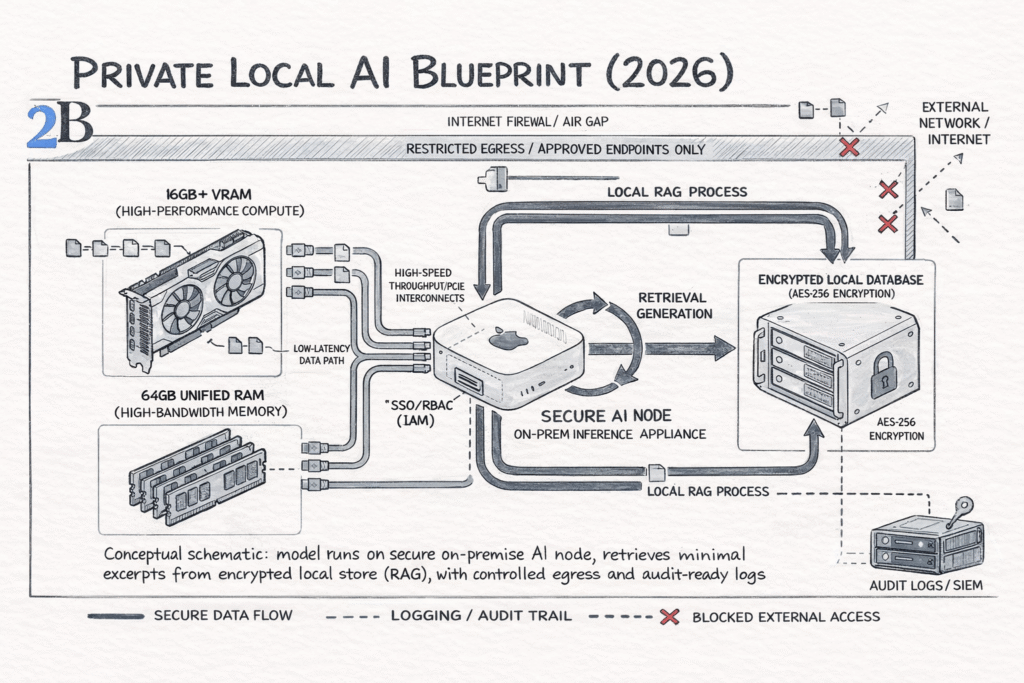
Technical schematic of an on-premise AI server architecture featuring local RAG workflow and secure data ingestion for insurance agencies

Implementing private local AI requires careful alignment of hardware, software, and governance controls to ensure consistent data protection. To build a resilient system, firms should align their on-premise infrastructure with the NIST AI Risk Management Framework, which provides an industry-recognized baseline for managing operational, security, and compliance risks in generative AI deployments.

Key challenges include selecting compute resources that balance cost and workload demands, choosing an on-premise–optimized software stack, and designing retrieval-augmented generation (RAG) architectures that preserve data residency and auditability. Addressing these factors enables measurable risk reduction and sustained control over proprietary client information, supporting long-term HIPAA and GLBA compliance.

4.1. Hardware Essentials: The Compute Power You Need

Hardware selection fundamentally determines model performance and scalability. For small to mid-sized firms, the Mac Mini M4 has emerged as a high-performance local AI server, offering a cost-effective entry point that balances high unified memory bandwidth with low power consumption.

  • GPU advantages: Superior parallel processing, preferred for large language models (LLMs) and deep learning fine-tuning, reducing run-time substantially.
  • CPU advantages: More cost-effective for smaller models or inference-only tasks, easier to maintain but typically slower for training.
  • Memory and Storage: High RAM capacity and SSD storage are critical for low latency and large dataset handling, crucial when dealing with voluminous client records or property databases.
  • Network Considerations: Ensuring internal data traffic remains on secured local networks prevents leakage and aids compliance with data residency obligations.

4.2. Software Stack: Tools for Local AI Deployment

Deploying private AI locally requires picking software that supports self-hosting and model management. This architecture enables firms to run high-reasoning models like DeepSeek R1 locally with GPT-4 level performance, ensuring that complex document analysis or policy underwriting happens without sending a single byte of data to third-party servers.

  • LocalAI: Open-source platform engineered for local LLM deployment, allowing granular control over model selection and updates.
  • Ollama: Provides seamless integration with desktop applications, supporting varied workflows while ensuring data remains on-premise.
  • LM Studio: Desktop application facilitating model downloading, customization, and offline use tailored for business-specific cases.
  • Model Fine-Tuning: Adjusting base models with domain-specific datasets (e.g., commercial real estate listings, insurance claim data) enhances accuracy and relevance.

4.3. Data Ingestion & Secure RAG Architecture (Retrieval Augmented Generation)

RAG architecture combines pretrained LLMs with dedicated local data retrieval systems to generate context-sensitive outputs without exposing private data to the cloud. Properly designed, it enforces strict data locality and enables auditability.

  • Data Ingestion Pipelines: Define secure connectors from structured data sources—CRM, property databases, or claims management systems—funneling into encrypted local indexes.
  • Vector Indexing: Convert documents into vector representations stored locally, enabling the LLM to fetch relevant live context while prohibiting external data exposure.
  • Access Controls & Auditing: Implement role-based permissions and logging to monitor data access and avoid compliance breaches.
  • Latency Management: Efficient indexing and caching strategies balance responsiveness with retrieval precision for user interactions.
ComponentKey ConsiderationsBenefitsTrade-offs
Hardware
(GPU vs. CPU)
Compute power, cost, maintenancePerformance scaling, cost-efficiencyGPU higher upfront cost, CPU lower speed
Software Stack
(LocalAI, Ollama, LM Studio)
Compatibility, extensibility, supportFull control, offline useRequires in-house expertise, limited cloud benefits
RAG Architecture
Secure Data Ingestion & Indexing
Data privacy, latency, securityStronger compliance alignment, contextual accuracyComplex setup, resource-demanding indexing

Integrating these components thoughtfully creates a robust, privacy-centric AI environment that aligns tightly with regulatory demands in real estate and insurance, while delivering AI-powered insights without compromising control. The next steps focus on operationalizing data workflows and compliance monitoring.

5. The ROI of Privacy: Calculating Your Local AI Advantage

As businesses in real estate and insurance evaluate AI adoption, understanding the full return on investment (ROI) of private local AI solutions is critical. Beyond upfront costs, ROI includes tangible savings from reduced compliance risks and less visible—yet equally impactful—benefits like enhanced client trust and reputational capital.

Private local AI secures sensitive data on-premise, minimizing exposure to breaches and regulatory penalties. This mitigates costly fines under regulations like HIPAA (Health Insurance Portability and Accountability Act) and GLBA (Gramm-Leach-Bliley Act), which can financially dwarf the savings from cloud subscription fees. The challenge is accurately modeling these multifaceted savings to justify upfront investments.

5.1. Beyond Cloud Subscriptions: Long-Term Cost Savings Analysis

Financial line chart showing the break-even point between recurring cloud AI subscription fees and the one-time investment in private local AI hardware.
Illustrative cost comparison between cloud AI subscriptions and private local AI infrastructure over 60 months. Values represent typical enterprise-scale scenarios and may vary based on workload, pricing, and implementation.

Recurring cloud AI subscription costs accumulate rapidly, especially as data volume and query complexity grow. In contrast, local AI requires an initial infrastructure investment but offers predictable, fixed-cost ownership over time.

  • On-premise hardware amortization: Spreading equipment costs over multiple years stabilizes budgeting.
  • Elimination of per-request fees: Unlike cloud AI, local models incur no extra charges per interaction.
  • Reduced bandwidth and latency costs: Enhances efficiency in locations with limited or costly connectivity.
  • Integration with existing IT assets: Maximizes ROI by leveraging current security and compliance infrastructure.

5.2. Quantifying Compliance & Risk Mitigation: A Financial Framework

Compliance breaches can result in fines ranging from thousands to millions of dollars, damage to business operations, and costly remediation. A risk-adjusted cost-benefit analysis helps quantify how local AI reduces such exposure:

  • Probability of breach: Reduced by maintaining data internally and using robust access controls.
  • Average cost per breach: Industry benchmarks reveal can exceed $9 million in major incidents in data-intensive sectors.
  • Insurance premium impacts: Lower risk profiles can reduce cybersecurity insurance costs.
  • Regulatory audit ease: In-house data management simplifies compliance verification workflows.

5.3. The Intangible Asset: Client Trust and Reputational Value

Trust is particularly paramount in real estate and insurance, where clients entrust agencies with highly sensitive personal and financial information. Private local AI boosts confidence by visibly prioritizing data protection, thus fostering loyalty and reducing client churn.

  • Brand differentiation: Privacy commitments establish distinct market positioning.
  • Client retention: Trust reduces turnover costs, which in insurance can reach 15–20% annually in competitive markets.
  • Referral impact: Satisfied clients bring inbound leads, improving customer acquisition ROI.
  • Regulatory goodwill: Proactive privacy practices support smoother expansions and partnerships.
ROI ComponentBenefitQuantifiable MetricTrade-offs/Considerations
Infrastructure CostFixed-cost ownership vs. ongoing SaaS feesAnnual depreciation, TCO over 3-5 yearsHigher initial capex, requires IT maintenance
Compliance & Risk MitigationLower breach probability, audit easeCost avoidance from fines, insurance savingsNeeds consistent policy enforcement; training costs
Client Trust & ReputationIncreased loyalty, higher retentionReduced churn %, referral ratesHarder to monetize directly; long-term payoff

When considering AI investments, organizations must evaluate local AI not just by direct costs but by its holistic impact on compliance, risk reduction, and client relationships. Robust financial and business models integrating these factors will ensure more accurate ROI projections and better strategic decisions. Next, we will explore practical deployment frameworks that maximize these advantages within your existing infrastructure.

6. Navigating the Trade-offs: When Cloud AI Still Makes Sense

Understanding when to leverage cloud AI despite the growing appeal of private local AI is critical for realistic, ROI-driven decision-making. This section explores the nuanced trade-offs between control, scalability, and resource allocation that real estate and insurance firms face when choosing AI deployment models.

While private local AI offers robust data privacy and compliance advantages, its operational demands and scaling challenges create scenarios where cloud AI remains the pragmatic option. Evaluating these trade-offs in the specific context of sensitive, regulated data environments ensures aligned technology investments.

6.1. Scalability vs. Control: Finding Your Firm’s Balance

Cloud AI platforms excel at handling variable workloads, enabling firms to scale AI capabilities dynamically without upfront infrastructure investment. However, this externalization often entails relinquishing direct control over data processing, which can conflict with HIPAA or GLBA compliance requirements.

  • Cloud AI offers elastic scaling and rapid deployment but requires rigorous vendor risk management.
  • Private local AI ensures complete control at the cost of finite scalability constrained by onsite resources.
  • Regulated industries may face higher compliance burdens with cloud AI due to shared responsibility models.

Decision-makers must weigh the ability to scale AI services easily against the imperative to maintain data silos under tight control frameworks.

6.2. Maintenance & Expertise: Internal vs. External Resources

Maintaining private local AI infrastructure demands significant internal expertise in areas such as hardware management, model updating, and security patching. Small to mid-sized firms often struggle with these overheads, making cloud alternatives attractive despite data privacy reservations.

  • Private local AI requires hiring or training in specialized IT and AI operational roles.
  • Cloud AI vendors typically handle maintenance, updates, and security, removing these burdens from the firm.
  • The trade-off is decreased customization and potential hidden costs related to vendor SLAs and support models.

Firms should assess their capacity to build a sustainable internal AI team against long-term costs and compliance risks associated with outsourcing these responsibilities.

6.3. Hybrid Approaches: Combining the Best of Both Worlds

Hybrid AI architectures enable firms to retain control over the most sensitive workflows locally while leveraging cloud AI for non-sensitive or high-volume tasks. This model optimizes cost-efficiency and compliance but introduces integration complexity.

  • Local AI handles private client data requiring strict compliance.
  • Cloud AI supports scalable analytics, model training, or public data processing.
  • Requires robust data governance policies and secure connectors to mitigate cross-environment risk.

Strategic hybrid deployment provides a pragmatic pathway for firms seeking incremental migration without sacrificing either privacy or scale.

DimensionPrivate Local AICloud AIHybrid Approach
Data ControlFull control; data never leaves premisesLimited control; vendor manages data environmentControl on local sensitive data; cloud for less sensitive
ScalabilityLimited by local infrastructure; capital-intensive to scaleHighly elastic, pay-as-you-go scalingSelective scale for cloud tasks; local scales selectively
Compliance ComplexitySimplified compliance management internallyComplex due to shared responsibility and vendor auditsBalanced compliance with clear boundary governance
Maintenance & Expertise RequiredHigh; requires in-house AI and IT capabilitiesMinimal; vendor handles platform managementModerate; specialized teams maintain local systems and integrations
Cost ModelCapital expenditure with ongoing ops costOperational expenditure, often subscription-basedMixed CapEx and OpEx depending on workload split

Considering the trade-offs outlined here empowers firms to make nuanced, compliance-aligned AI deployment decisions tailored to evolving business and regulatory landscapes. Next, we explore technical strategies to effectively set up private local AI environments optimized for sensitive data workflows.

Conclusion: Secure Your Data, Secure Your Future with Private Local AI

As AI adoption accelerates in sensitive sectors like real estate and insurance, prioritizing data privacy is non-negotiable. Private local AI emerges as a pivotal approach that balances computational power with airtight compliance, safeguarding client information while delivering scalable business insights.

This model mitigates the critical risks posed by cloud-based AI solutions, notably regulatory non-compliance and data exposure, by processing data on-premise or within secure local environments. Firms gain control over their AI workflows and can embed privacy-by-design principles without sacrificing performance.

The Imperative of Data Guardianship in the AI Era

Protecting sensitive data must extend beyond traditional IT measures to encompass AI infrastructures. Increasing incidents of cloud data leaks and algorithmic mismanagement highlight compliance gaps under HIPAA, GLBA, and other privacy regulations. Local deployment ensures data remains within a firm’s trusted perimeter, which is crucial for maintaining legal adherence and customer trust.

  • Regulatory Compliance: On-premise AI reduces risks of cross-border data transfer violations and uncontrolled third-party access.
  • Data Sovereignty: Firms retain jurisdictional control, simplifying audit and reporting requirements.
  • Risk Reduction: Local environments limit the attack surface, reducing breach likelihood and subsequent financial penalties.
  • Transparency & Control: Full custody over data pipelines increases accountability and aligns with ethical AI standards.

Your Next Step: Assessing Your Firm’s Private AI Potential

Integrating private local AI requires a strategic appraisal of your operational needs, compliance mandates, and IT capabilities. Consider these pragmatic evaluation criteria to guide your implementation roadmap:

  • Data Sensitivity Profiling: Catalog data types and pinpoint those demanding local processing to comply with HIPAA, GLBA, or similar frameworks.
  • Infrastructure Readiness: Evaluate existing hardware and network capacity to host AI workloads securely and efficiently.
  • Cost-Benefit Balance: Analyze ROI factoring in reduced regulatory fines, reputational risk mitigation, and potential operational efficiencies.
  • Vendor & Open-source Options: Explore models and platforms that support on-premise deployment with strong privacy guarantees.
  • Change Management: Plan staff training and integration processes to smoothly adopt private AI tools without disrupting workflows.
Assessment CriteriaKey QuestionsImplications
Data SensitivityWhich data elements are regulated or sensitive?Determines scope for local processing mandatory for compliance
InfrastructureDo we have sufficient on-premise compute and security controls?Identifies gaps requiring investment or hybrid cloud strategies
ComplianceWhat regulations impact our AI-driven workflows?Shapes AI deployment architecture and audit practices
Cost & ROIWhat savings or revenues arise from increased privacy assurance?Justifies budget allocation and long-term investment
User AdoptionHow to ensure seamless transition and employee engagement?Supports training and change management plans

Careful alignment of these factors will maximize the strategic advantage private local AI offers, positioning your firm to harness AI innovation while upholding the highest standards of privacy and trust. Consider how this framework applies to evolving your AI infrastructure securely.


Disclaimer: This article is for educational and informational purposes only. Cost estimates, ROI projections, and performance metrics are illustrative and may vary depending on infrastructure, pricing, workload, implementation and overtime. We recommend readers should evaluate their own business conditions and consult qualified professionals before making strategic or financial decisions.

Leave a Reply

Your email address will not be published. Required fields are marked *