Physical Address
304 North Cardinal St.
Dorchester Center, MA 02124
Physical Address
304 North Cardinal St.
Dorchester Center, MA 02124


Most solo founders don’t have a productivity problem. They have a planning problem. They end the week having responded to everything, shipped nothing meaningful, and wondered where 40 hours went. In our experience working with lean agency operators, the ones who consistently hit their priorities aren’t working more hours — they’ve built a planning system that separates signal from noise before Monday starts.
The difference between a chaotic week and a productive one almost never comes down to the number of hours available. It comes down to whether those hours were pre-assigned to the work that actually moves the business.
This article gives you a practical work planning framework built for solo founders and 1–5 person agencies. Not a general productivity method repackaged for entrepreneurs — a system built around the reality that you’re simultaneously doing client delivery, business development, and operations with no one to hand off to.
Work planning for solo founders is the practice of deliberately allocating focused time blocks to high-leverage tasks before reactive work — client messages, admin, and inbound requests — fills the available hours. Unlike corporate planning systems designed for teams with clear role boundaries, solo founder planning must account for constant role-switching: on any given day, the same person is the strategist, the executor, and the account manager. Research from the University of California, Irvine shows it takes an average of 23 minutes to fully regain focus after an interruption. For a founder switching contexts a dozen times a day, that’s not a minor inconvenience — it’s hours of productive capacity lost before noon.
The most common planning mistake isn’t skipping planning altogether — it’s planning by urgency. You open Monday morning, scan your inbox and Slack, and build your week around whatever is loudest. Client requests, overdue invoices, a tool that broke, a proposal that needs revising. By Thursday, the actual growth work — the outreach, the content, the system-building — hasn’t been touched because it was never urgent enough to fight its way onto the calendar.
This pattern has a name in productivity research: reactive scheduling. And it’s structurally guaranteed to keep a solo business in maintenance mode rather than growth mode.
The second mistake is confusing a to-do list with a plan. A list tells you what exists. A plan tells you when it happens and what it displaces. Without time assignment, every task on your list competes equally for attention — which means the easiest tasks win, not the highest-leverage ones.
The third mistake is under-protecting deep work. Solo founders doing any kind of client work, content creation, or product development need uninterrupted blocks to produce quality output. We’ve found that most solo founders get fewer than two hours of uninterrupted focused time per day — not because they lack discipline, but because their calendar is structured to make interruption the default.
Before building a planning system, you need a mental model for what kinds of work actually exist in your week. Every task you do falls into one of three modes. Mixing them without awareness is what creates the fragmented, exhausting weeks most solo founders default to.
We use this three-mode framework because it makes planning decisions concrete. Rather than asking “what should I do today?”, you ask “what mode does today need to protect?”
The planning insight here is simple: Maker Mode work should be scheduled first, in your highest-energy hours. Manager and Maintenance Modes fill the gaps around it. Most solo founders do this backwards — they clear the reactive work first and try to find focus time in whatever’s left. There’s rarely anything left.
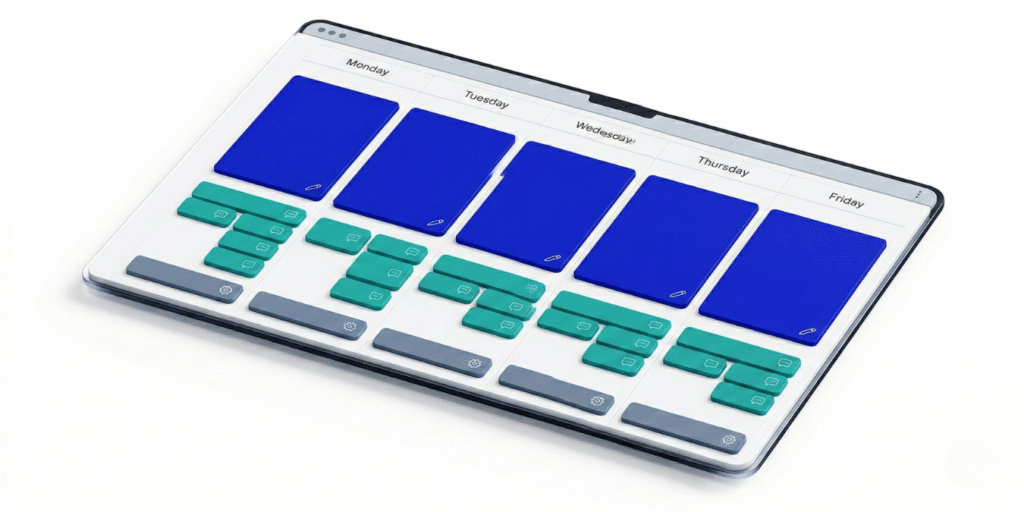
A weekly planning system for a solo founder needs to be fast, repeatable, and honest. It can’t take 90 minutes every Sunday — that’s not sustainable. The version we use takes 20–30 minutes on Friday afternoon, and it makes Monday morning a decision that’s already been made.
The Friday review is the most skipped step and the most valuable one. Without it, your planning system doesn’t learn — you just repeat the same structural mistakes on a weekly cycle. We’ve found that founders who score their weeks honestly for four consecutive weeks identify a pattern: usually one recurring distraction type or one recurring planning error that accounts for most of their lost leverage time.
The structural tension for solo founders running client work is real: you can’t disappear for three hours when a client is waiting on a deliverable or a question. But you also can’t produce quality work in 20-minute windows between messages. This is the core planning challenge that generic productivity advice fails to address.
The solution isn’t to force yourself to ignore messages. It’s to set communication expectations with clients that create reliable focus windows without damaging the relationship.
Practically, this means building two defined communication windows into every workday — a 30–45 minute block in mid-morning to clear overnight messages, and a second block in mid-afternoon for same-day follow-ups. Outside those windows, Slack, email, and other async tools stay closed. Not silenced — closed.
The distinction matters: silenced notifications still pull your attention because you know they’re accumulating. Closed applications remove that cognitive pull entirely. Research from Gloria Mark at UC Irvine found that even knowing an interruption might come reduces focus quality — the anticipation is itself a focus leak.
For client-facing agencies, the additional tool that makes this work is Loom for async video updates. Rather than a live check-in call that requires both parties to be available simultaneously, a 3-minute Loom update at the end of a work session keeps clients informed without creating a calendar collision. It also creates a documentation trail, which is useful when scope questions come up later.
The planning system described above works with almost any combination of tools. What it doesn’t work with is too many tools, or tools that require maintenance of their own. Here’s what we’ve seen work consistently for solo founders and 1–5 person agencies.
| Tool | Best For | Weak Spot | Price |
|---|---|---|---|
| ClickUp | Solo founders managing multiple client projects with recurring tasks | Over-featured — easy to build a system you then have to maintain | Free tier available; paid from $7/user/mo |
| Notion | Founders who want planning + docs + SOPs in one place | No native time-blocking; requires manual calendar coordination | Free tier available; paid from $10/mo |
| Google Calendar | Time-blocking the three work modes; visual week structure | No task management — needs a companion tool for task capture | Free |
| Reclaim.ai | Auto-scheduling tasks around existing calendar commitments | Requires clean calendar hygiene to work well; can over-schedule | Free tier; paid from $8/user/mo |
Pricing reflects plans available at the time of writing. Tool pricing changes frequently — always verify current plans on each tool’s official website before making a purchasing decision.
For most solo founders, the simplest effective stack is: ClickUp or Notion for task capture and project tracking, Google Calendar for time-blocking the three work modes, and Loom for async client updates. That’s three tools with clear, non-overlapping jobs. Adding a fourth tool — especially an AI scheduling tool like Reclaim.ai — is only worth it once the manual system is working. Automating a broken planning habit doesn’t fix the habit.
No weekly plan survives contact with a real client. A project blows up, a deliverable takes twice as long, someone goes quiet and then sends 12 messages in a row. The question isn’t how to prevent this — it’s how to absorb it without the whole week collapsing.
The answer is built-in slack. Not laziness — structural margin. One unscheduled afternoon per week. No more than 80% of your working hours pre-committed. That 20% isn’t wasted time; it’s the buffer that makes the other 80% actually executable.
The other resilience mechanism is outcome-based prioritization rather than task-based. If your week’s goal is “close the retainer renewal,” you know exactly what to protect when time compresses. If your week’s goal is “do client work,” you have no triage lever because everything qualifies.
We’ve seen the pattern consistently: founders who plan by outcome make better real-time decisions when disruption hits. Founders who plan by task list tend to reprioritize by urgency under pressure — which puts them back in reactive mode regardless of what their original plan said.
20–30 minutes on Friday afternoon is the target. More than 45 minutes usually means you’re planning instead of deciding — a common avoidance pattern. The brain dump, three outcomes, calendar blocking, and Friday scoring should each take 5–10 minutes maximum. If your planning sessions regularly run long, the system is too complex.
Both, at different levels. Weekly planning defines your three outcomes and assigns time blocks. Daily planning — a 5-minute check each morning — confirms what those blocks contain and adjusts for anything that shifted overnight. The weekly plan is the structure; the daily check is the real-time calibration. Skipping the weekly layer and only doing daily planning leaves you without a prioritization anchor when urgency competes with importance.
Three outcomes is the maximum that can be reliably protected in a week that also includes client delivery, communication, and admin. Four or more is aspirational, not executable. If all three outcomes require deep work time, you’ll likely hit two of the three on a normal week — which, over a month, is substantial progress. The trap is setting six “priorities” and hitting two of them, then feeling behind despite identical output.
You reset the expectation, usually once, upfront. Most clients develop the same-day expectation because nobody told them otherwise — not because they genuinely need it. A short note explaining your communication windows (e.g., “I check messages at 9am and 3pm”) signals professionalism and reliability, not unavailability. The rare client who genuinely requires instant access to a solo operator is usually the wrong client for a solo operator’s business model.
Time-blocking creative work doesn’t mean predicting exactly what you’ll produce — it means protecting the conditions under which production is possible. You’re not blocking “write article” and expecting it to be done in 90 minutes. You’re blocking “write article, uninterrupted, no messages, nothing else” and accepting that the outcome will vary. The block isn’t a deadline; it’s a focus container. That distinction makes time-blocking work for creative work in a way that rigid task scheduling doesn’t.
If you’re consistently ending weeks frustrated by how little got done on the things that actually matter, the problem is structural, not motivational. Reactive scheduling is the default state for solo operators — it requires deliberate effort to override. The three-mode framework, the four-step planning rhythm, and outcome-based prioritization give you the specific mechanisms to override it.
Start with the Friday review. Even if you don’t change anything else about how you work next week, spending 20 minutes on Friday naming three outcomes and putting them on the calendar will produce a noticeable difference by Wednesday. That’s the right entry point — not a complete system overhaul, just one consistent habit that starts anchoring your decisions.
For the broader operational context this planning system sits inside, see our guide to building a lean agency operations stack. For the project-level structure that supports this week-to-week rhythm, the project dashboard setup guide for small agencies covers how to track client work without turning your tool into a second job.
Last updated: March 2026
