Physical Address
304 North Cardinal St.
Dorchester Center, MA 02124
Physical Address
304 North Cardinal St.
Dorchester Center, MA 02124

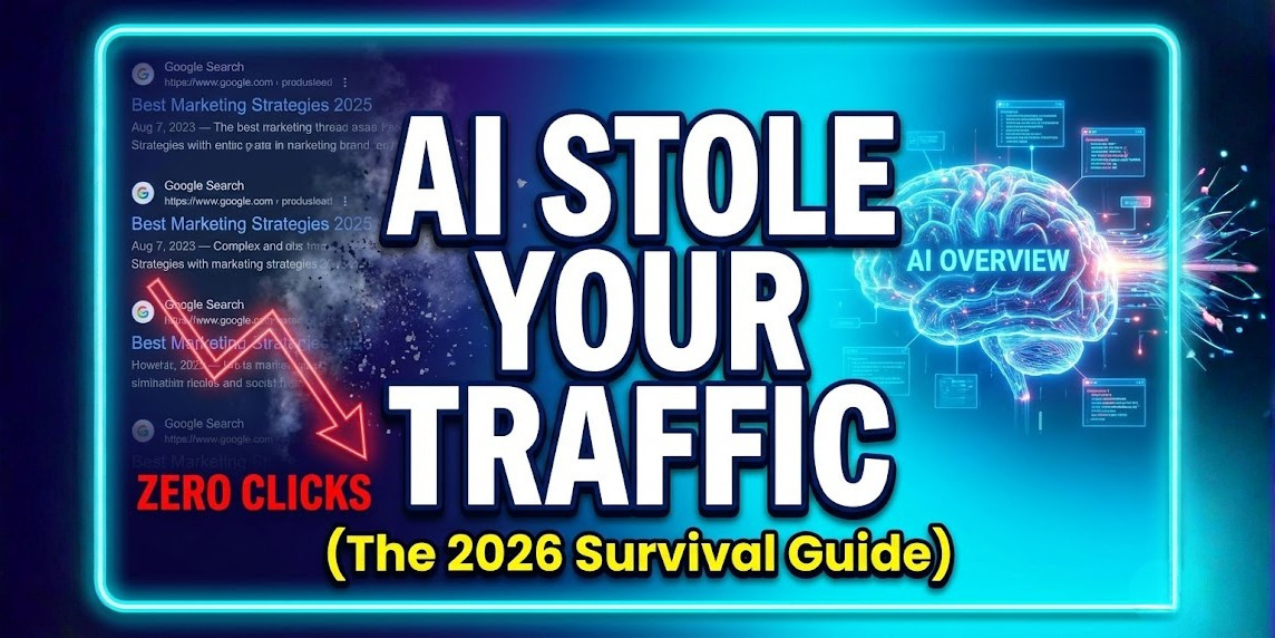
Google AI Overviews are changing how search traffic works in 2026 — and that shift is hitting blogs first. For most of the last 20 years, “search traffic” meant something simple: Google shows blue links, you earn the click, and your site turns that visit into revenue (ads, affiliate, leads, email list).
In 2026, that model is breaking in slow motion — AI Overviews are one of the biggest reasons why. Instead of sending the user to your article to get the answer, Google increasingly summarizes the answer directly on the results page, pulling from multiple sources and satisfying the intent without a click.
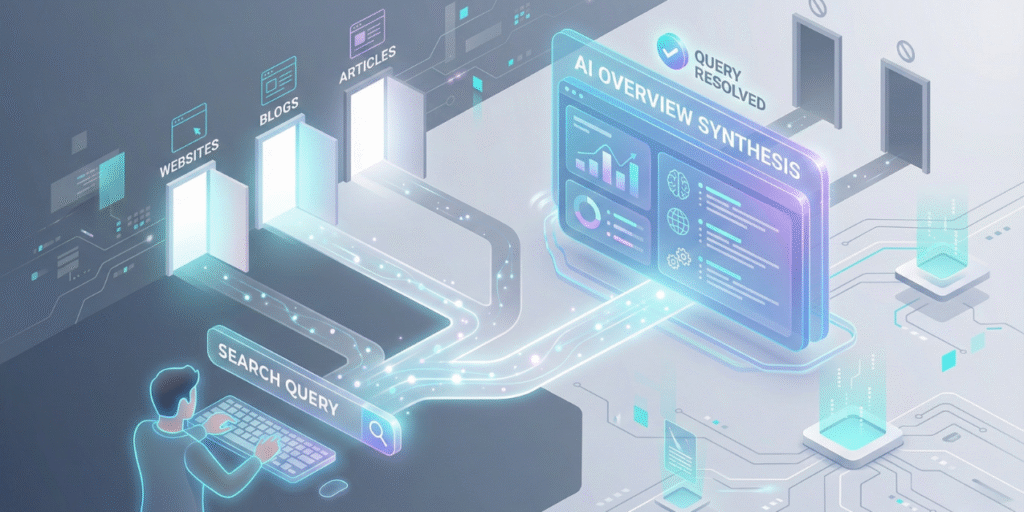
This isn’t “SEO is dead” clickbait. It’s a market shift: search is becoming a destination, not a doorway. And if your content is easy for an AI to summarize, you’ll feel the pressure first — especially with listicles, generic comparisons, and basic definitions.
In this report, we’ll map what’s changing, why it matters for creators, and how to redesign content so your site still gets traffic even when the SERP tries to keep users inside Google.
🚀 TL;DR — What Should You Do About AI Overviews in 2026?
👉 This article focuses on the American search market, where AI Overviews and “zero-click” behaviors are accelerating fastest.
Google has always answered some queries directly (weather, sports scores, unit conversions). That’s not new. What is new is the scope: according to Google’s official documentation on AI Overviews the system can now synthesize multi-step answers — including recommendations, pros/cons, checklists, and “best options” — which used to be exactly the kind of content that sent traffic to blogs.
So the threat isn’t “Google is stealing content.” The threat is that the SERP is becoming the product. If the user gets “good enough” right there, they don’t need to click.
| Then (Classic SEO) | Now (AI Overview Era) |
|---|---|
| Google routes intent to publishers | Google resolves intent inside the SERP |
| Your article is the “answer” | Your article is “training data + citation” |
| Ranking = clicks | Ranking may equal visibility, not visits |
| Generic listicles can win | Generic listicles get summarized |
| More content = more traffic | More content = more competition for fewer clicks |
We saw this play out in our own analytics this month. One of our reports regarding the Play.ht shutdown received 113 impressions in a single week but 0 clicks.
The Problem: Our initial title was purely informational. Google’s AI Overview summarized the news, satisfying the user’s curiosity without needing a click.
The Pivot: We shifted the angle from “News” to a “Migration & Data Recovery Guide.” By offering a specific process and proof of how to protect vocal assets, we moved the content from “summarizable” to “essential.” In 2026, if you aren’t offering a workflow, you’re just providing training data for Google for free.
AI Overviews disproportionately reduce clicks on queries where the user intent is informational and the answer can be “packed” into a clean summary. That’s why new blogs feel the squeeze: most new sites start by targeting broad informational keywords, which are exactly the easiest to synthesize.
If your post is basically “what everyone already knows,” your upside is limited. Even if you rank, the click-through rate can shrink because the user already got the punchline.
Visual: Where Clicks Get “Compressed” in 2026
Note: These bars are a strategy visualization (not official Google data). The point is to show which content types are easiest to “compress” into an AI summary.
AI Overviews tend to pull content that is structured, scannable, and confidently stated — especially:
If your post is basically a clean bundle of these elements, it’s perfect “summary fuel.” That doesn’t mean you should avoid clarity — it means you must combine clarity with something the AI can’t fully replicate: proof, process, and specific experience.
SERP Flow: Classic Search vs. AI Overview Search
1) Classic Search (Clicks as the default)
2) AI Overview Search (Answers as the default)
The new game: give the SERP a clean answer, but reserve the real value (proof, screenshots, experiments, tools) for your page.
Next, we’ll get tactical: the exact content patterns that still earn clicks in 2026, how to format posts so Google can cite you and users still need your page, and how to choose “AI-resistant” keywords for a new blog.
The key shift is simple: Google can summarize answers, but it struggles to summarize proof. If your page contains real evidence (screenshots, original tests, templates, numbers, comparisons you actually ran), users still click because they want certainty — not a generic summary.
So instead of writing “the best AI tool is X,” you design pages that make the reader think: “I need to see how they tested this.”
| Content Type | How AI Overviews Handle It | How You Still Win the Click |
|---|---|---|
| Generic listicle | Summarized into 5–8 bullets | Replace “best” with tested: include your methodology + real outputs |
| Basic definition | Fully answered in SERP | Add decision frameworks, edge cases, and “when it fails” |
| Comparison post | Pros/cons summarized | Bring artifacts: tables from your own tests + screenshots + settings |
| How-to guide | Steps summarized | Add a “pitfalls” section + fixes + exact UI clicks + before/after |
| Tool recommendation | AI gives “good enough” picks | Target specific scenarios (budget, compliance, accents, workflow, platform) |
To stay “AI-resistant,” your article needs at least one strong reason for a human to visit your page instead of reading the SERP summary. Here are the patterns that consistently survive:
✅ “Click Reasons” That AI Overviews Can’t Fully Replace
Screenshots of real workflows
Show the UI, settings, and outputs. The reader wants to copy what worked.
Original tests & measurable comparisons
Same prompt, same script, same constraints — then publish the results.
Decision trees (“If X, choose Y”)
AI can list options, but a decision tree maps the reader’s exact situation to a choice.
Pitfalls & fixes (the “stuff that breaks”)
Your best traffic comes from readers stuck mid-process who need the exact fix.
Templates, checklists, and downloadables
A SERP can summarize a checklist, but users still want a copy/paste version.
Counterintuitive truth: you don’t want to “hide” your answer from Google. You want to do a two-layer structure:
That’s why the best-performing 2026 posts feel like this: answer → evidence → decision.
Blueprint: “Answer → Evidence → Decision” Layout
A) Fast Answer (for AI Overviews)
A short TL;DR box with 5–7 bullets that directly answers the query.
B) Evidence (for clicks)
Screenshots, test tables, settings, example prompts, output clips, and “what failed.”
C) Decision (for conversion)
A decision tree + recommendation by scenario + internal links to deeper comparisons.
Result: you get cited in the overview and still earn the click because your page contains the proof.
In the U.S. market, the highest-risk queries are broad and informational (“best AI voice generator,” “what is X,” “how does X work”). The safest queries are the ones where the user is already in motion and needs a specific answer to proceed.
| Keyword Type | Example | Why It Still Gets Clicks |
|---|---|---|
| Setup / troubleshooting | “why ElevenLabs voices sound robotic fix” | User needs a specific fix, not a summary |
| Workflow-based | “best AI voice for 30 minute narration” | Requires constraints + proof + comparisons |
| Compliance / policy | “AI voice cloning commercial use rules” | People want sources + nuance + risk context |
| Tool migrations | “migrate from Play.ht to ElevenLabs” | Action-driven intent, needs steps & checklists |
| Cost math | “ElevenLabs pricing per hour” | Users want calculations, real examples, and limits |
Notice the pattern: these queries are not “learn” queries — they’re “do” queries. And “do” queries still click, because failing costs time and money.
If clicks shrink, many publishers panic and assume the site is dying. But in 2026, visibility and branding can rise while clicks fluctuate. That’s why your KPI stack should expand beyond pageviews.
2026 KPI Stack (Recommended)
1) Search visibility
Impressions and average position (you can win visibility even when clicks compress).
2) Brand lift
Growth in branded searches (people typing “Like2Byte + tool name”).
3) Conversion events
Email signups, affiliate clicks, outbound clicks, time on page, scroll depth.
4) Returning visitors
The real moat: readers who come back because your site has proof-based content.
Surviving AI Overviews is just the first step. Build your authority and income with these proven 2026 frameworks:
Next, we’ll turn this into a practical execution plan: what to publish first, how to build “proof libraries” fast, and how to use internal linking so no article becomes orphaned — even as the SERP changes.
The fastest way to win in 2026 is not volume — it’s sequence. You want to publish content in an order that compounds authority, captures migration traffic, and prevents orphaned posts.
Below is a proven 30-day publishing sequence optimized for the U.S. market and AI-affected SERPs.
| Week | What to Publish | Why It Works |
|---|---|---|
| Week 1 | Market shift / shutdown article | Captures breaking demand + backlinks + branded searches |
| Week 2 | Migration & replacement guide | High “do-intent” queries that still earn clicks |
| Week 3 | Deep comparison (tested) | Supports AI Overviews while pulling proof-seekers |
| Week 4 | Workflow-specific how-to | Creates evergreen traffic + internal link targets |
This order ensures that every new article immediately links to — and is supported by — existing content.
AI can summarize opinions. It cannot summarize artifacts. Your goal is to quietly build a private library of proof that aligns with C2PA digital provenance standards, proving that your data, screenshots, and tests are original and haven’t been synthesized by another AI.
What Counts as Proof in 2026
UI screenshots
Exact settings, sliders, toggles, pricing dashboards
Side-by-side outputs
Same prompt → different tools → visible differences
Cost math tables
Characters → minutes → real monthly spend
Failure cases
What breaks, where it fails, and how to fix it
One proof asset can power multiple articles across comparisons, migrations, and troubleshooting posts.
In 2026, internal linking is no longer an SEO afterthought — it’s how you teach Google what your site is about.
The rule is simple: every article must play one of three roles.
| Role | Purpose | Examples |
|---|---|---|
| Pillar | Defines the topic | Best AI Voice Generators (2026) |
| Shift / News | Captures spikes & authority | Play.ht shutdown analysis |
| Action | Solves a specific problem | Migrate from Play.ht to ElevenLabs |
Each article must link up to a pillar and laterally to at least two related action articles. If it doesn’t, it’s unfinished.
When traffic becomes more selective, monetization improves — because the reader intent is stronger.
Monetization Stack That Still Works
Affiliate links
Best placed after proof, not at the top
Email capture
“Migration checklist” beats generic newsletters
High-CPM ads
AI, finance, SaaS still outperform lifestyle niches
When AI can generate unlimited text, the real scarcity is no longer information — it’s context, verification, and judgment. That’s why Like2Byte is built around curation, not volume.
“In 2026, people don’t click blogs to get information — they click to find judgment they can trust.”
AI Overviews didn’t kill blogs. They killed lazy publishing.
The blogs that survive in 2026 do three things exceptionally well:
If you treat every article as a tested report instead of an opinion piece, your site doesn’t compete with AI — it becomes the source AI learns from.
That’s the Like2Byte edge.
1. Is Play.ht permanently shut down?
Yes. Play.ht’s independent SaaS platform officially shut down on December 31, 2025. After its acquisition by Meta in mid-2025, the PlayAI technology was fully absorbed into Meta’s internal ecosystem and is no longer available as a standalone commercial product.
2. Why did Meta shut down Play.ht instead of keeping it as a paid tool?
Meta’s priority is ecosystem control, not SaaS revenue. Integrating PlayAI directly into Llama, Meta AI, and hardware like Ray-Ban smart glasses provides far more long-term value than maintaining a $30/month subscription product for creators.
3. What is the best replacement for Play.ht in 2026?
It depends on your use case. ElevenLabs is the top choice for expressive narration and YouTube content. Fish Audio is the strongest alternative for creators who want long-form stability and protection from future platform shutdowns through open-source or local deployment.
4. Is ElevenLabs at risk of being acquired or shut down?
There is no public indication of an imminent acquisition. However, the Play.ht shutdown proves that creators should avoid relying on a single provider. Maintaining access to original voice samples and diversifying tools is now considered best practice.
5. Are AI market shifts like this becoming more common?
Yes. Between 2024 and 2026, the AI industry shifted rapidly from independent SaaS tools toward vertically integrated platforms. Voice, image, and video AI are increasingly being absorbed into operating systems, hardware, and closed ecosystems.
6. How can creators protect themselves from future AI shutdowns?
The safest strategy is to maintain control over your original training data, favor tools that allow export or local usage, and treat AI voices as long-term digital assets — not disposable SaaS features.
7. Will Google AI Overviews reduce traffic to articles like this?
AI Overviews may answer surface-level questions, but they still rely on authoritative sources. Articles that include timelines, comparisons, migration paths, and first-hand analysis continue to earn clicks — especially from users making real decisions.